Mr. Stubb says Europe would back U.S. against Iran, but concedes U.S. and Israel are acting ‘outside framework of international law’
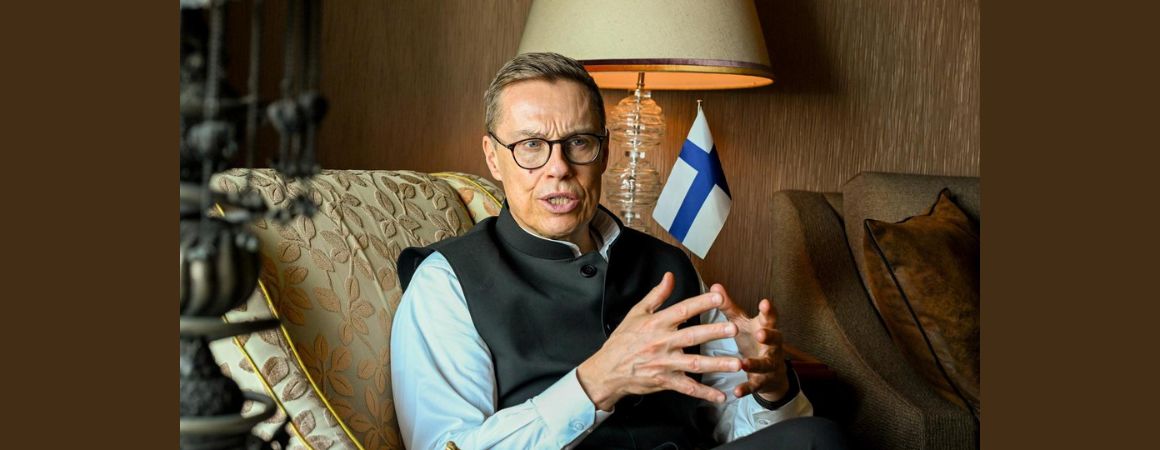
It is necessary to stop the West Asia war from spreading, emphasised Finnish President Alexander Stubb, who also voiced concerns on the U.S. sinking an Iranian ship in the Indian Ocean. Mr. Stubb, who is seen as a close ally of U.S. President Donald Trump said that while European countries would side with America in the conflict, he did believe that the U.S. and Israel were acting “outside the framework of traditional international law” with their strikes on Iran that assassinated the country’s Supreme Leader Ayatollah Ali Khamenei on February 28. On the sidelines of the Raisina Dialogue in Delhi where he was the chief guest, Mr. Stubb said the non-alignment policy suited a country of India’s size and geography. Excerpts:
 Are you concerned that [the war in West Asia] could spread? After the attack by the U.S. on an Iranian ship in the Indian Ocean, are you concerned that this is now headed towards a world war, and do you see an end game?
 If we look at the trends of conflicts since the end of the Cold War, first, they were local, wars of independence, that led to the emergence of new states. Now, I would argue, ever since Russia’s war of aggression in Ukraine, [conflicts] have become regional and we’ve seen that trend grow. Israel-Palestine, now Israel-U.S.-Iran, and then Iran versus the Gulf states. We should try to avoid to make this war into a global conflict, and use all de-escalatory means necessary at this stage. The less states are hit by this, the better. But the truth, of course, is that we can’t be ostriches and put our heads in the sand. The price of oil will have an impact. The closing of the Hormuz Strait will have an impact on global trade. We’re all affected by this, but now we just need to contain it.
Spain, France and today, Slovenia have very clearly condemned the U.S.-Israel attacks, which were the first strike in this war. Yet countries, including Finland, have not. Is Europe divided over what has happened?
No, I think it is as united as Europe is. I mean, it’s 27 states. Even on the war in Russia, we have disparate voices from, for instance, Hungary and partially Slovakia. So European foreign policy is never perfect. But if the question was, do we back America or Iran, I think the answer is very clear, we back America.
Despite the fact that U.S.-Israel cast the first strike?
Despite that fact, and you can, of course, see the United Kingdom and France allowing the United States to use their bases for the strike. So in that sense, I think it’s quite clear where their sympathies are.
You discussed the war in Ukraine with Prime Minister Narendra Modi and there was a reference to it in the joint statement. Was there anything you requested India to do?
We had a really good and engaging conversation on many conflicts around the world. For a country like Finland, the key conflict is Russia’s war of aggression in Ukraine. So I was able to explain to Prime Minister Modi why there are security concerns about Russian aggression in the region, I think both of us were very focused on a path towards peace. I’ve had the chance to discuss with the main U.S. and Ukrainian negotiators a week ago, where we stand in the peace negotiations on the three key documents of the 20-point plan, security guarantees and the prosperity plan, and then we were reflecting on how we could take things forward. India is a peace-loving nation, and India is one of the few that can talk to both Russia and to Ukraine on an equal footing and with equal respect from both leaders.
The U.S. has announced it is giving India a 30-day waiver from sanctions to buy Russian oil. How do you respond to that?
(Smiles) You know, I’m a humble President from a country of 5.6 million people. I’m not going to intervene in the international relations or diplomacy between India and the United States.
Do you hope India will continue to decrease Russian oil imports as it has for some months?
I don’t give advice to a leader from a country that has 7% annual growth rate and a population of a little bit less than 1.5 billion. I can only explain what the impact of oil purchases are for the Russian war machinery, but it’s not my decision, it’s for India to decide itself. We’re in a complicated geopolitical situation, and we were able to discuss that.
The Finnish government announced it is preparing to allow the acquisition of nuclear weapons. Why this major change in position?
Let me begin by dismantling a misunderstanding. This is not about Finland acquiring nuclear weapons. We have no such plans, and Finland will not become a nuclear state. It is about erasing an anomaly in Finnish legislation. There was a law crafted some 40 years ago (1987) during the Cold War, which criminalised the possession and transport of nuclear weapons on Finnish soil, and since we became NATO members, it’s quite clear that NATO’s deterrence is based on three pillars. One is conventional forces, two is missiles, and three is nuclear weapons. And what we are basically doing now is two things. One is that we’re bringing our legislation to the same level as the other Nordic states. And secondly, we are dismantling any impediments to us being a part of NATO’s nuclear planning. So we want to be a 100% NATO member state, and that’s why we’re doing this change. It’s not against anyone. It’s for our own security.
Obviously, a lot has changed in Europe with the Russian invasion of Ukraine, but has this change also got something to do with the fact that the U.S. seems to have a new and very mercurial foreign policy, and states in Europe are feeling much more insecure?
No, there is no imminent nuclear threat to Finland. We are part of NATO’s nuclear planning, and at the end of the day, the biggest security umbrella that we have comes from the nuclear weapons of the United States, and our defence cooperation with the U.S. bilaterally has never been closer than it is right now. It is a relationship of mutual interest and mutual benefits. So we’re not doing this because we’re interested in European nuclear weapons. We’re doing it because we want to be part of NATO’s nuclear planning, and we fully understand and encourage European states such as France and the United Kingdom to continue to develop their nuclear [assets] and use them within the NATO umbrella.
It’s interesting because we’re looking at a war in the Middle East that has been ostensibly set off by the idea of not letting Iran have a nuclear weapon.
Good point.
I wanted to ask about what’s seen as double standards in this war: the U.S. and Israel have carried out strikes to take out the head of another state, invade the territory, do away with the sovereignty in a manner that has not been condemned as much by you or by other members of the European Union as in the past. Have US and Israeli actions made the international rule of law untenable?
No. As I said in my (Raisina Dialogue) speech, just because you violate the speed limit doesn’t make the law on limits of speed null and void. I think it is quite clear that Israel and the United States are working outside the framework of traditional international law. It is also clear that building nuclear weapons in Iran is against international law, and the attacks that Iran has launched on 10 states in the Middle East and the Gulf and also in Europe with Cyprus, and Turkey and Azerbaijan are also outside the scope of international law. I think sometimes the problem with the analysis on international relations and politics is that there is an assumption that it’s completely black and white. I think from an analytical perspective, it is safe to say that the U.S. is working in a different context than they did with Libya, with Afghanistan and with Iraq, in the sense that in all three cases, they first sought a U.N. mandate and partially got one in Afghanistan, but they then consulted many of their allies. The U.S. doesn’t do that anymore… its foreign policy is complicated sometimes.
At the Raisina Dialogue inaugural speech you called for a “New Delhi moment” conference to discuss the new multilateral world order. Do you suggest that the United Nations should be replaced?
No, we need to revise the United Nations. Don’t throw the baby out with the bath water. The UN has served us well for roughly 80 years. Not every country equally well, but I believe that if we want to save the multilateral liberal world order, which I believe that India wants to save as well, then we need to rebalance the power structures in these institutions. We need to have them reflect the world of 2026, not the world of 1945, and that’s why countries like India need to have a permanent seat in the UN Security Council. That’s why the power balance in the financial institutions such as the IMF, the World Bank and the WTO needs to be changed and revamped.
You praised India for its non-alignment and multi-alignment since Independence. Why do you think that has worked for India?
Because your geographic location is different and your size is very different, you’re able to project power in a way in which a small country cannot. For me, power is influence. For you, power is soft, hard, smart and influence. So there’s a big difference.
Is there a way to bring the Global North and South closer together?
Yes, in several different ways. I believe in regional integration, which would mean that the countries of the global south in this region would forge cooperation or an alliance. It can also be in the G format, like G20 where the global south is better represented. What at the end of the day binds us together is values, and this is a conversation that I had extensively with Prime Minister Modi, who, after all, represents the biggest democracy in the world. So there are a lot of things that I think unite us more than divide us, and I think that’s what we need to work on. So begin with the regional stuff, and then move on to the global multilateral institutions.
With the EU-India FTA done, what areas can India and Finland double their trade in now?
I think there are three areas that we should focus on. All of them are basically tech related. The first one is on networks, for the 5G network here, I see a few masts, 50% of these are Nokia. The second is quantum, which basically feeds and enables artificial intelligence. Finland has a very strong quantum sector, with two companies that are in the top 10 in the world. And then the third one is satellites. I think we share not only values, but a concept of data privacy, and we know that future data centres will also be in space. I’m here with roughly 20 companies from Finland, two of which are satellite companies.
Many Indians will tell you their first mobile phone was a Nokia, but few would have one today. Would you like to see Nokia back on the map?
You know, a mobile phone is only an enabler. 10 years from now, we probably won’t have mobile phones. We’ll have something planted in our ear or something in our retina or our glasses, which basically replaces the phone. So Nokia was a trailblazer when it came to mobile phones, but now it’s a trailblazer for networks. I think Nokia is probably doing the right thing. There are some Nokia phones still around, but again, it’s just a tool.
We back America over Iran, but now we just need to de-escalate this war: Finland President Alexander Stubb
Mr. Stubb says Europe would back U.S. against Iran, but concedes U.S. and Israel are acting ‘outside framework of international law’
It is necessary to stop the West Asia war from spreading, emphasised Finnish President Alexander Stubb, who also voiced concerns on the U.S. sinking an Iranian ship in the Indian Ocean. Mr. Stubb, who is seen as a close ally of U.S. President Donald Trump said that while European countries would side with America in the conflict, he did believe that the U.S. and Israel were acting “outside the framework of traditional international law” with their strikes on Iran that assassinated the country’s Supreme Leader Ayatollah Ali Khamenei on February 28. On the sidelines of the Raisina Dialogue in Delhi where he was the chief guest, Mr. Stubb said the non-alignment policy suited a country of India’s size and geography. Excerpts:
Are you concerned that [the war in West Asia] could spread? After the attack by the U.S. on an Iranian ship in the Indian Ocean, are you concerned that this is now headed towards a world war, and do you see an end game?
If we look at the trends of conflicts since the end of the Cold War, first, they were local, wars of independence, that led to the emergence of new states. Now, I would argue, ever since Russia’s war of aggression in Ukraine, [conflicts] have become regional and we’ve seen that trend grow. Israel-Palestine, now Israel-U.S.-Iran, and then Iran versus the Gulf states. We should try to avoid to make this war into a global conflict, and use all de-escalatory means necessary at this stage. The less states are hit by this, the better. But the truth, of course, is that we can’t be ostriches and put our heads in the sand. The price of oil will have an impact. The closing of the Hormuz Strait will have an impact on global trade. We’re all affected by this, but now we just need to contain it.
Spain, France and today, Slovenia have very clearly condemned the U.S.-Israel attacks, which were the first strike in this war. Yet countries, including Finland, have not. Is Europe divided over what has happened?
No, I think it is as united as Europe is. I mean, it’s 27 states. Even on the war in Russia, we have disparate voices from, for instance, Hungary and partially Slovakia. So European foreign policy is never perfect. But if the question was, do we back America or Iran, I think the answer is very clear, we back America.
Despite the fact that U.S.-Israel cast the first strike?
Despite that fact, and you can, of course, see the United Kingdom and France allowing the United States to use their bases for the strike. So in that sense, I think it’s quite clear where their sympathies are.
You discussed the war in Ukraine with Prime Minister Narendra Modi and there was a reference to it in the joint statement. Was there anything you requested India to do?
We had a really good and engaging conversation on many conflicts around the world. For a country like Finland, the key conflict is Russia’s war of aggression in Ukraine. So I was able to explain to Prime Minister Modi why there are security concerns about Russian aggression in the region, I think both of us were very focused on a path towards peace. I’ve had the chance to discuss with the main U.S. and Ukrainian negotiators a week ago, where we stand in the peace negotiations on the three key documents of the 20-point plan, security guarantees and the prosperity plan, and then we were reflecting on how we could take things forward. India is a peace-loving nation, and India is one of the few that can talk to both Russia and to Ukraine on an equal footing and with equal respect from both leaders.
The U.S. has announced it is giving India a 30-day waiver from sanctions to buy Russian oil. How do you respond to that?
(Smiles) You know, I’m a humble President from a country of 5.6 million people. I’m not going to intervene in the international relations or diplomacy between India and the United States.
Do you hope India will continue to decrease Russian oil imports as it has for some months?
I don’t give advice to a leader from a country that has 7% annual growth rate and a population of a little bit less than 1.5 billion. I can only explain what the impact of oil purchases are for the Russian war machinery, but it’s not my decision, it’s for India to decide itself. We’re in a complicated geopolitical situation, and we were able to discuss that.
The Finnish government announced it is preparing to allow the acquisition of nuclear weapons. Why this major change in position?
Let me begin by dismantling a misunderstanding. This is not about Finland acquiring nuclear weapons. We have no such plans, and Finland will not become a nuclear state. It is about erasing an anomaly in Finnish legislation. There was a law crafted some 40 years ago (1987) during the Cold War, which criminalised the possession and transport of nuclear weapons on Finnish soil, and since we became NATO members, it’s quite clear that NATO’s deterrence is based on three pillars. One is conventional forces, two is missiles, and three is nuclear weapons. And what we are basically doing now is two things. One is that we’re bringing our legislation to the same level as the other Nordic states. And secondly, we are dismantling any impediments to us being a part of NATO’s nuclear planning. So we want to be a 100% NATO member state, and that’s why we’re doing this change. It’s not against anyone. It’s for our own security.
Obviously, a lot has changed in Europe with the Russian invasion of Ukraine, but has this change also got something to do with the fact that the U.S. seems to have a new and very mercurial foreign policy, and states in Europe are feeling much more insecure?
No, there is no imminent nuclear threat to Finland. We are part of NATO’s nuclear planning, and at the end of the day, the biggest security umbrella that we have comes from the nuclear weapons of the United States, and our defence cooperation with the U.S. bilaterally has never been closer than it is right now. It is a relationship of mutual interest and mutual benefits. So we’re not doing this because we’re interested in European nuclear weapons. We’re doing it because we want to be part of NATO’s nuclear planning, and we fully understand and encourage European states such as France and the United Kingdom to continue to develop their nuclear [assets] and use them within the NATO umbrella.
It’s interesting because we’re looking at a war in the Middle East that has been ostensibly set off by the idea of not letting Iran have a nuclear weapon.
Good point.
I wanted to ask about what’s seen as double standards in this war: the U.S. and Israel have carried out strikes to take out the head of another state, invade the territory, do away with the sovereignty in a manner that has not been condemned as much by you or by other members of the European Union as in the past. Have US and Israeli actions made the international rule of law untenable?
No. As I said in my (Raisina Dialogue) speech, just because you violate the speed limit doesn’t make the law on limits of speed null and void. I think it is quite clear that Israel and the United States are working outside the framework of traditional international law. It is also clear that building nuclear weapons in Iran is against international law, and the attacks that Iran has launched on 10 states in the Middle East and the Gulf and also in Europe with Cyprus, and Turkey and Azerbaijan are also outside the scope of international law. I think sometimes the problem with the analysis on international relations and politics is that there is an assumption that it’s completely black and white. I think from an analytical perspective, it is safe to say that the U.S. is working in a different context than they did with Libya, with Afghanistan and with Iraq, in the sense that in all three cases, they first sought a U.N. mandate and partially got one in Afghanistan, but they then consulted many of their allies. The U.S. doesn’t do that anymore… its foreign policy is complicated sometimes.
At the Raisina Dialogue inaugural speech you called for a “New Delhi moment” conference to discuss the new multilateral world order. Do you suggest that the United Nations should be replaced?
No, we need to revise the United Nations. Don’t throw the baby out with the bath water. The UN has served us well for roughly 80 years. Not every country equally well, but I believe that if we want to save the multilateral liberal world order, which I believe that India wants to save as well, then we need to rebalance the power structures in these institutions. We need to have them reflect the world of 2026, not the world of 1945, and that’s why countries like India need to have a permanent seat in the UN Security Council. That’s why the power balance in the financial institutions such as the IMF, the World Bank and the WTO needs to be changed and revamped.
You praised India for its non-alignment and multi-alignment since Independence. Why do you think that has worked for India?
Because your geographic location is different and your size is very different, you’re able to project power in a way in which a small country cannot. For me, power is influence. For you, power is soft, hard, smart and influence. So there’s a big difference.
Is there a way to bring the Global North and South closer together?
Yes, in several different ways. I believe in regional integration, which would mean that the countries of the global south in this region would forge cooperation or an alliance. It can also be in the G format, like G20 where the global south is better represented. What at the end of the day binds us together is values, and this is a conversation that I had extensively with Prime Minister Modi, who, after all, represents the biggest democracy in the world. So there are a lot of things that I think unite us more than divide us, and I think that’s what we need to work on. So begin with the regional stuff, and then move on to the global multilateral institutions.
With the EU-India FTA done, what areas can India and Finland double their trade in now?
I think there are three areas that we should focus on. All of them are basically tech related. The first one is on networks, for the 5G network here, I see a few masts, 50% of these are Nokia. The second is quantum, which basically feeds and enables artificial intelligence. Finland has a very strong quantum sector, with two companies that are in the top 10 in the world. And then the third one is satellites. I think we share not only values, but a concept of data privacy, and we know that future data centres will also be in space. I’m here with roughly 20 companies from Finland, two of which are satellite companies.
Many Indians will tell you their first mobile phone was a Nokia, but few would have one today. Would you like to see Nokia back on the map?
You know, a mobile phone is only an enabler. 10 years from now, we probably won’t have mobile phones. We’ll have something planted in our ear or something in our retina or our glasses, which basically replaces the phone. So Nokia was a trailblazer when it came to mobile phones, but now it’s a trailblazer for networks. I think Nokia is probably doing the right thing. There are some Nokia phones still around, but again, it’s just a tool.




NO COMMENT