Austria, a neutral country, signs a rare MoU on military cooperation with India
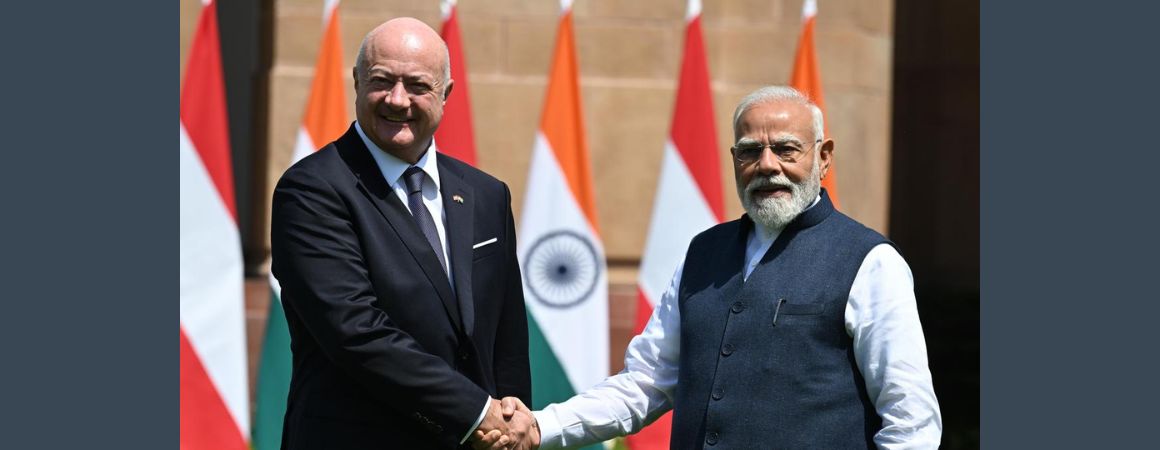
The global situation is “grave and tense”, said Prime Minister Narendra Modi, speaking after talks with Austrian Chancellor Christian Stocker, as both leaders asserted that current conflicts in Ukraine and West Asia could not be resolved militarily. Announcing a number of agreements of intent after talks, the two countries said they hoped to cooperate on military matters and terrorism while launching a dialogue on cybersecurity.
The visit by Mr. Stocker, his first in Asia, comes two years after Mr. Modi visited Vienna and met with the then Chancellor Karl Nehammer, who lost elections. In addition, officials said the two leaders determined to build on the India-EU Free Trade Agreement and Strategic Partnership announced in January 2026.
“Today, the entire world is passing through a very grave and tense situation, and its impact is being felt by us all,” Mr. Modi said, addressing the media at Hyderabad House. “In such a tense global environment, India and Austria share the conviction that military conflict cannot provide a solution to problems. Be it Ukraine or West Asia, we advocate for a stable, sustainable, and lasting peace,” he added.
‘Rules-based order’
In his statement, Chancellor Stocker said both sides were in favour of the “rules-based order” and “not a world in which might is right”.
“We are living in an age of geopolitical people and disruption. Power centers are shifting, and new alliances are being created, and conflicts are becoming more complex,” said Mr. Stocker, adding that India was a reliable partner for Austria as it shared “fundamental values at a time when geopolitical challenges are getting stronger”.
“Prime Minister [Modi] and I share the view that peace in all conflicts can only be achieved through negotiation. And the voice of India carries a lot of weight, bilaterally and also in international forums,” he added.
Briefing the media about the agreements during the visit, which is the first by an Austrian Chancellor in four decades, the Ministry of External Affairs said the “Letter of Intent” on defence cooperation would provide an institutional framework for India and Austria to work on defence integration and technology development and facilitate a defence policy dialogue and training, as well as cooperation in United Nations peacekeeping missions, along with other Memorandums of Understanding (MoUs) in security and strategic areas.
“There are two defence corridors that [India] is developing, one in the south and one in the north. A significant number of European countries are participating in that, and Austria is one of them, with a partnership at various levels,” said Secretary (West) Sibi George.
The agreements are rare for Austria, officials explained, as it is a “neutral country” like Switzerland that is a member of the European Union but not the military alliance NATO. After the second World War, Austria gained its independence from Soviet occupation after negotiations helped by former Prime Minister Jawaharlal Nehru with Moscow, declaring neutrality. The 1955 constitutional declaration ensured Austria would permanently refrain from joining military alliances and would not allow foreign military bases on its soil. In later decades Austria and India were instrumental in building a “North-South” dialogue between the developed countries and the developing world. In recent years, Austria has been increasingly critical of Russia for the invasion of Ukraine in 2022, but has remained militarily neutral, providing Ukraine with humanitarian aid.
After talks in Delhi, the two sides also signed several MoUs and LoIs in education, including easing vocational training, taking forward the 2023 mobility agreement and “working holiday” programmes. Pointing out that Austrian companies have helped in Indian infrastructure projects, including the Delhi Metro, Atal tunnel (Himachal Pradesh), railway projects and Gujarat’s Girnar Ropeway, Mr. Modi said he hoped for further infrastructure cooperation between the two countries. He said technology partnerships would combine “Austria’s expertise with India’s speed and scale” for the world.
“Both sides agreed to establish a fast-track mechanism to address issues faced by companies and investors in both countries at an early stage,” the joint statement issued at the end of Mr. Stocker’s visit noted.
No military solution to conflicts, say PM Modi and Austrian Chancellor Stocker
Austria, a neutral country, signs a rare MoU on military cooperation with India
The global situation is “grave and tense”, said Prime Minister Narendra Modi, speaking after talks with Austrian Chancellor Christian Stocker, as both leaders asserted that current conflicts in Ukraine and West Asia could not be resolved militarily. Announcing a number of agreements of intent after talks, the two countries said they hoped to cooperate on military matters and terrorism while launching a dialogue on cybersecurity.
The visit by Mr. Stocker, his first in Asia, comes two years after Mr. Modi visited Vienna and met with the then Chancellor Karl Nehammer, who lost elections. In addition, officials said the two leaders determined to build on the India-EU Free Trade Agreement and Strategic Partnership announced in January 2026.
“Today, the entire world is passing through a very grave and tense situation, and its impact is being felt by us all,” Mr. Modi said, addressing the media at Hyderabad House. “In such a tense global environment, India and Austria share the conviction that military conflict cannot provide a solution to problems. Be it Ukraine or West Asia, we advocate for a stable, sustainable, and lasting peace,” he added.
‘Rules-based order’
In his statement, Chancellor Stocker said both sides were in favour of the “rules-based order” and “not a world in which might is right”.
“We are living in an age of geopolitical people and disruption. Power centers are shifting, and new alliances are being created, and conflicts are becoming more complex,” said Mr. Stocker, adding that India was a reliable partner for Austria as it shared “fundamental values at a time when geopolitical challenges are getting stronger”.
“Prime Minister [Modi] and I share the view that peace in all conflicts can only be achieved through negotiation. And the voice of India carries a lot of weight, bilaterally and also in international forums,” he added.
Briefing the media about the agreements during the visit, which is the first by an Austrian Chancellor in four decades, the Ministry of External Affairs said the “Letter of Intent” on defence cooperation would provide an institutional framework for India and Austria to work on defence integration and technology development and facilitate a defence policy dialogue and training, as well as cooperation in United Nations peacekeeping missions, along with other Memorandums of Understanding (MoUs) in security and strategic areas.
“There are two defence corridors that [India] is developing, one in the south and one in the north. A significant number of European countries are participating in that, and Austria is one of them, with a partnership at various levels,” said Secretary (West) Sibi George.
The agreements are rare for Austria, officials explained, as it is a “neutral country” like Switzerland that is a member of the European Union but not the military alliance NATO. After the second World War, Austria gained its independence from Soviet occupation after negotiations helped by former Prime Minister Jawaharlal Nehru with Moscow, declaring neutrality. The 1955 constitutional declaration ensured Austria would permanently refrain from joining military alliances and would not allow foreign military bases on its soil. In later decades Austria and India were instrumental in building a “North-South” dialogue between the developed countries and the developing world. In recent years, Austria has been increasingly critical of Russia for the invasion of Ukraine in 2022, but has remained militarily neutral, providing Ukraine with humanitarian aid.
After talks in Delhi, the two sides also signed several MoUs and LoIs in education, including easing vocational training, taking forward the 2023 mobility agreement and “working holiday” programmes. Pointing out that Austrian companies have helped in Indian infrastructure projects, including the Delhi Metro, Atal tunnel (Himachal Pradesh), railway projects and Gujarat’s Girnar Ropeway, Mr. Modi said he hoped for further infrastructure cooperation between the two countries. He said technology partnerships would combine “Austria’s expertise with India’s speed and scale” for the world.
“Both sides agreed to establish a fast-track mechanism to address issues faced by companies and investors in both countries at an early stage,” the joint statement issued at the end of Mr. Stocker’s visit noted.




NO COMMENT