Rafael Grossi, who is running for the UN Secretary General this year, says ‘war has returned in a furious way to different parts of the world’; he says the UN is still relevant in today’s world
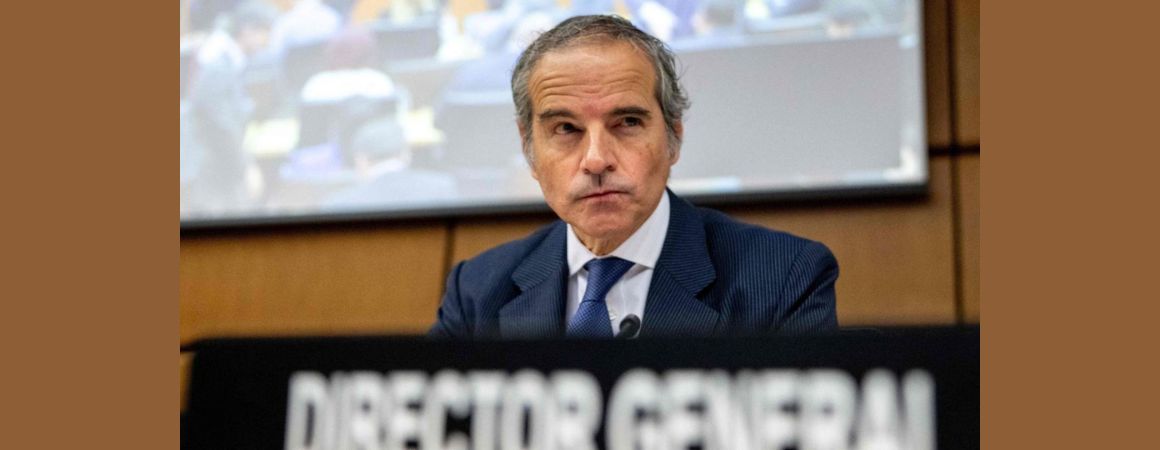
Attacks like the one on Iran’s Bushehr nuclear site must never happen again, and the world needs to discuss avoiding a moment where nuclear weapons, even in a limited way, would be used, says Director-General of International Atomic Energy Agency Rafael Grossi, welcoming the news of the U.S.-Iran ceasefire. In an exclusive interview to The Hindu, Mr. Grossi, who is running for UN Secretary General this year, says UNSC reform is possible, and that India has a “legitimate” claim to a seat.
 What is your reaction to this ceasefire, that has been announced, and the talks ahead?
 As a diplomat, as a man of peace, as the head of an international organisation in the area of peace and international security, I would say that we are relieved and we are happy to see that at least, for some time, the war is stopping, and that an opening is there in front of us for diplomacy. The real solution, the long-standing solution for this war, in this case, lies on a diplomatic table. Naturally, as you rightly say, one of the main bone of contention has been the nuclear programme and many interrogations around it. The IAEA will play a constructive role to support these processes, as we have been doing in the past.
How worried are you that the kind of conflict we’ve seen already, the strikes near Bushehr, Isfahan, other nuclear sites, have had a dangerous impact?
If you are asking very specifically about radiological consequences, there have been none so far, which doesn’t mean that what has been happening is not serious and grave. I want to be very clear about this. We were very concerned this past weekend, when a number of quite direct hits were seen inside the premises of the Bushehr nuclear power plant, and we have been in touch, of course, with all sides, Iran, Israel, with the United States. And also with Russia, because this is a plant that has been built, and it is at least partially operated by the state company Rosatom from Russia. So we have been engaging in some consultations with all in order to try to prevent the occurrence of this type of event in the future. So far, so good, but of course, it’s something that should never, should never happen.
On Tuesday (April 7, 2026), as the deadline was emerging, Mr. Trump put out a statement saying a civilization could die. His Vice-President spoke about using extreme measures. Was there a point which you were worried?
I’m always worried. At the IAEA, we are always on alert. We have been playing a role in two ongoing wars – one that has reached a ceasefire point, and another that hasn’t, between the Russian Federation and Ukraine, so we’re always on a state of alert.
Of course, there was a concern, but at the same time, as even President Trump was saying that there were intense negotiations ongoing, there was hope. Thanks to the very efficient work of mediation, [India’s] neighbours in Pakistan, Egypt and some others who were trying to bring, the two belligerents together [we have a ceasefire]. It’s good to see that the diplomatic effort is starting in just a couple of days. The concern is always there, and it will continue to be until we find a permanent agreement.
Eighty years after an atomic bomb was used (Hiroshima and Nagasaki), we’re seeing these two conflicts in which you have to use nuclear diplomacy to try and get the parties involved to take a step back. How dangerous do you think this trend is?
We have been coexisting and living with nuclear weapons for the past 80 years, and they are a reality. But we see with these conflicts the impact of what may happen if there is any use or threat of use of nuclear weapons. We see that this [nuclear threat] is not hypothetical. Now we see more conversation and not so oblique references to nuclear weapons. So, indeed, it is a moment of reflection where we as the international community, the IAEA, the United Nations, have to reflect upon these realities to make sure that we do not get to a moment where nuclear weapons, even in a limited way, would be used.
You actually said very clearly there was no evidence that Iran was moving towards a nuclear weapon right at the beginning of this conflict. Was there pressure from the U.S. and Israel as they made their case for war, and how did you deal with it?
Well, the pressure is always there when you are dealing with matters that go to the heart of international peace and security. There is no way around it. In this particular case, we have been trying to keep an objective line, which is difficult. We have been very, very clear in the sense that there is no evidence of a systematic, organised, permanent, institutionalised programme to manufacture nuclear weapons. But there were other elements as well that should be considered. The accumulation, the continued accumulation of highly enriched uranium, were some things that Iran was not responding to, as we said in our reports to the IAEA Board. Of course, pressures are always there, and it would be unnatural that they are not existing. It may be uncomfortable for me, even for my personal life, we have been subject to threats, but [for us] the objective is peace and to prevent situations of conflict that may lead to war.
You are a candidate for the United Nations Secretary General elections this year. What can you achieve, and why have you decided to stay on as DG-IAEA even as you run for the office – which is considered unusual?
The UN is firmly based on a number of pillars. Peace and security is one pillar, and development, and human rights and humanitarian issues are also very important. We are in a world at war. War has returned in a furious way to different parts of the world, even in your country and the neighbourhood (India-Pakistan), and in Cambodia-Thailand. We have seen it in Azerbaijan-Armenia, Sudan and South Sudan. We see it in East Congo and Rwanda. We see it, of course, in Ukraine and Russia.
So, this is the reality. This is not because we are side-lining other aspects which are every bit as important, but when the world is at war in the way it is, I think we need to remember why the United Nations were established after the cataclysmic events of the Second World War. The IAEA and I have been engaged with the belligerents. We have been preventing nuclear accidents, we have been trying to move into the solution of this issue in Iran. This is, what inspired me and connects with the [UNSG election]. How irresponsible it would be for me to take leave when all these things are happening, and when the IAEA is having all these responsibilities within its mandate. I don’t think there is any contradiction or conflict of interest. On the contrary, I would argue, that for someone who is aspiring to have this higher role to leave his or her responsibilities behind, for me, would be a dereliction of duty.
Whether it is COVID, the Russian invasion of Ukraine, Israel’s attacks on Gaza, including on UN personnel, U.S.-Israel attacks on nuclear installations, assassinations, the international world order is coming apart, and it seems as if the United Nations and the Secretary General’s Office have had no effective role, no way of stopping them. Do you still think that the United Nations is relevant?
I would not disagree with your diagnosis. But it needn’t be so. This very gloomy evaluation of the efficiency of the United Nations is widely shared, unfortunately. At the same time, there is a recognition, the faith in the existence and the importance of the UN has not faded away. People continue to believe that the UN has an indispensable role.
A country like India is of global importance, and is in the UN, BRICS, G20 in many configurations, and the same could be said for other countries. There is one platform that unites us all. If we have global conflicts, you can discuss with your like-minded peers as much as you want. But you will need to have a platform where everybody will be present.
Even if everyone’s a member of the UN, the UNSC is certainly not representative of today’s realities. India has the largest population in the world and yet doesn’t have a spot. There are no countries from Africa and South America. Can you offer a way forward on reforming the UNSC, which seems stuck?
Well, the institution was created 80 years ago and we see this gap between the current realities. There is the example of India, and there are other countries that have claims as well. Obviously, the Secretary General does not have a magic wand. This is a process that countries themselves have decided to channel through an intergovernmental negotiating process to come to a solution. But of course, the Secretary General can do a lot in terms of having conversations, in terms of bringing people together, and also in terms of recognising the role of countries. India has a global role in any case. Of course, there is a legitimate aspiration there, and I have discussed this with my friend [External Affairs Minister] Jaishankar, who is one of the most brilliant Foreign Ministers I’ve met.
You spoke about the conflict India and Pakistan were involved in last year. India has repeatedly rejected the UN’s involvement in its bilateral disputes. India has also asked the UN monitoring observation group on India and Pakistan to wind up its operations. As UN Secretary General, what would be your stand?
Well, of course, this is a matter that has been under discussion since the advent of independent India and Pakistan. I think it’s a matter that needs to be discussed. I am very aware of the position of India, and also of Pakistan. I think it’s important that we recognise that, as it happened just a few months ago (May 2025), there is an issue of instability, that needs to be addressed in dialogue with all the parties.
You were involved very closely with India about a decade ago at the Nuclear Suppliers Group, over its application for membership, that hasn’t come through yet. Is there any chance of that now?
As chair of the Nuclear Suppliers Group (NSG), I was pushing for an NSG that would be reflective and inclusive of all the big players in the nuclear industry. And India continues to be one, which by the way, deserves to be congratulated for the very recent breakthrough in terms of the criticality of a fast breeder reactor that happened. That proves, once again, that all the countries that have a very important role to play in nuclear industry and trade should have a place at the Nuclear Suppliers Group. At that time (2016), we were not so far from getting it. Sometimes in international politics, windows of opportunity close abruptly, and that certainly happened at that time. But I continue to be optimistic about that possibility.
What stopped it? Or Who?
Well, it’s a matter of consensus, and the consensus was not there. We were negotiating the different points that were to be included in order to make space for India and others that were also, under my presidency, pushing for their accession to the group.
What I feel is very important is that the civil-nuclear programme, which is the one I work with from the IAEA in India, is growing. The atomic community in India is moving with new technologies. We are in a very good phase when it comes to nuclear energy, and a big economy like India requires a lot of energy.
Your bid for UNSG comes in a year many had hoped for the first woman UNSG. Why didn’t you stand aside for a woman candidate?
Because I feel that when it comes to elections, national or international, the element of gender should not be the deciding element. Once you have distinguished women candidates (for the UNSC election), the principle of equality is preserved, and then you should let the countries decide. I am a gender champion. I found an organisation with 28% of women professionals, and that is now at 52%. So I’m not only a firm believer, I have done things that others that may be talking about this have never done.
Worried by hits on Iran nuclear sites, must never happen again: IAEA chief Rafael Grossi
Rafael Grossi, who is running for the UN Secretary General this year, says ‘war has returned in a furious way to different parts of the world’; he says the UN is still relevant in today’s world
Attacks like the one on Iran’s Bushehr nuclear site must never happen again, and the world needs to discuss avoiding a moment where nuclear weapons, even in a limited way, would be used, says Director-General of International Atomic Energy Agency Rafael Grossi, welcoming the news of the U.S.-Iran ceasefire. In an exclusive interview to The Hindu, Mr. Grossi, who is running for UN Secretary General this year, says UNSC reform is possible, and that India has a “legitimate” claim to a seat.
What is your reaction to this ceasefire, that has been announced, and the talks ahead?
As a diplomat, as a man of peace, as the head of an international organisation in the area of peace and international security, I would say that we are relieved and we are happy to see that at least, for some time, the war is stopping, and that an opening is there in front of us for diplomacy. The real solution, the long-standing solution for this war, in this case, lies on a diplomatic table. Naturally, as you rightly say, one of the main bone of contention has been the nuclear programme and many interrogations around it. The IAEA will play a constructive role to support these processes, as we have been doing in the past.
How worried are you that the kind of conflict we’ve seen already, the strikes near Bushehr, Isfahan, other nuclear sites, have had a dangerous impact?
If you are asking very specifically about radiological consequences, there have been none so far, which doesn’t mean that what has been happening is not serious and grave. I want to be very clear about this. We were very concerned this past weekend, when a number of quite direct hits were seen inside the premises of the Bushehr nuclear power plant, and we have been in touch, of course, with all sides, Iran, Israel, with the United States. And also with Russia, because this is a plant that has been built, and it is at least partially operated by the state company Rosatom from Russia. So we have been engaging in some consultations with all in order to try to prevent the occurrence of this type of event in the future. So far, so good, but of course, it’s something that should never, should never happen.
On Tuesday (April 7, 2026), as the deadline was emerging, Mr. Trump put out a statement saying a civilization could die. His Vice-President spoke about using extreme measures. Was there a point which you were worried?
I’m always worried. At the IAEA, we are always on alert. We have been playing a role in two ongoing wars – one that has reached a ceasefire point, and another that hasn’t, between the Russian Federation and Ukraine, so we’re always on a state of alert.
Of course, there was a concern, but at the same time, as even President Trump was saying that there were intense negotiations ongoing, there was hope. Thanks to the very efficient work of mediation, [India’s] neighbours in Pakistan, Egypt and some others who were trying to bring, the two belligerents together [we have a ceasefire]. It’s good to see that the diplomatic effort is starting in just a couple of days. The concern is always there, and it will continue to be until we find a permanent agreement.
Eighty years after an atomic bomb was used (Hiroshima and Nagasaki), we’re seeing these two conflicts in which you have to use nuclear diplomacy to try and get the parties involved to take a step back. How dangerous do you think this trend is?
We have been coexisting and living with nuclear weapons for the past 80 years, and they are a reality. But we see with these conflicts the impact of what may happen if there is any use or threat of use of nuclear weapons. We see that this [nuclear threat] is not hypothetical. Now we see more conversation and not so oblique references to nuclear weapons. So, indeed, it is a moment of reflection where we as the international community, the IAEA, the United Nations, have to reflect upon these realities to make sure that we do not get to a moment where nuclear weapons, even in a limited way, would be used.
You actually said very clearly there was no evidence that Iran was moving towards a nuclear weapon right at the beginning of this conflict. Was there pressure from the U.S. and Israel as they made their case for war, and how did you deal with it?
Well, the pressure is always there when you are dealing with matters that go to the heart of international peace and security. There is no way around it. In this particular case, we have been trying to keep an objective line, which is difficult. We have been very, very clear in the sense that there is no evidence of a systematic, organised, permanent, institutionalised programme to manufacture nuclear weapons. But there were other elements as well that should be considered. The accumulation, the continued accumulation of highly enriched uranium, were some things that Iran was not responding to, as we said in our reports to the IAEA Board. Of course, pressures are always there, and it would be unnatural that they are not existing. It may be uncomfortable for me, even for my personal life, we have been subject to threats, but [for us] the objective is peace and to prevent situations of conflict that may lead to war.
You are a candidate for the United Nations Secretary General elections this year. What can you achieve, and why have you decided to stay on as DG-IAEA even as you run for the office – which is considered unusual?
The UN is firmly based on a number of pillars. Peace and security is one pillar, and development, and human rights and humanitarian issues are also very important. We are in a world at war. War has returned in a furious way to different parts of the world, even in your country and the neighbourhood (India-Pakistan), and in Cambodia-Thailand. We have seen it in Azerbaijan-Armenia, Sudan and South Sudan. We see it in East Congo and Rwanda. We see it, of course, in Ukraine and Russia.
So, this is the reality. This is not because we are side-lining other aspects which are every bit as important, but when the world is at war in the way it is, I think we need to remember why the United Nations were established after the cataclysmic events of the Second World War. The IAEA and I have been engaged with the belligerents. We have been preventing nuclear accidents, we have been trying to move into the solution of this issue in Iran. This is, what inspired me and connects with the [UNSG election]. How irresponsible it would be for me to take leave when all these things are happening, and when the IAEA is having all these responsibilities within its mandate. I don’t think there is any contradiction or conflict of interest. On the contrary, I would argue, that for someone who is aspiring to have this higher role to leave his or her responsibilities behind, for me, would be a dereliction of duty.
Whether it is COVID, the Russian invasion of Ukraine, Israel’s attacks on Gaza, including on UN personnel, U.S.-Israel attacks on nuclear installations, assassinations, the international world order is coming apart, and it seems as if the United Nations and the Secretary General’s Office have had no effective role, no way of stopping them. Do you still think that the United Nations is relevant?
I would not disagree with your diagnosis. But it needn’t be so. This very gloomy evaluation of the efficiency of the United Nations is widely shared, unfortunately. At the same time, there is a recognition, the faith in the existence and the importance of the UN has not faded away. People continue to believe that the UN has an indispensable role.
A country like India is of global importance, and is in the UN, BRICS, G20 in many configurations, and the same could be said for other countries. There is one platform that unites us all. If we have global conflicts, you can discuss with your like-minded peers as much as you want. But you will need to have a platform where everybody will be present.
Even if everyone’s a member of the UN, the UNSC is certainly not representative of today’s realities. India has the largest population in the world and yet doesn’t have a spot. There are no countries from Africa and South America. Can you offer a way forward on reforming the UNSC, which seems stuck?
Well, the institution was created 80 years ago and we see this gap between the current realities. There is the example of India, and there are other countries that have claims as well. Obviously, the Secretary General does not have a magic wand. This is a process that countries themselves have decided to channel through an intergovernmental negotiating process to come to a solution. But of course, the Secretary General can do a lot in terms of having conversations, in terms of bringing people together, and also in terms of recognising the role of countries. India has a global role in any case. Of course, there is a legitimate aspiration there, and I have discussed this with my friend [External Affairs Minister] Jaishankar, who is one of the most brilliant Foreign Ministers I’ve met.
You spoke about the conflict India and Pakistan were involved in last year. India has repeatedly rejected the UN’s involvement in its bilateral disputes. India has also asked the UN monitoring observation group on India and Pakistan to wind up its operations. As UN Secretary General, what would be your stand?
Well, of course, this is a matter that has been under discussion since the advent of independent India and Pakistan. I think it’s a matter that needs to be discussed. I am very aware of the position of India, and also of Pakistan. I think it’s important that we recognise that, as it happened just a few months ago (May 2025), there is an issue of instability, that needs to be addressed in dialogue with all the parties.
You were involved very closely with India about a decade ago at the Nuclear Suppliers Group, over its application for membership, that hasn’t come through yet. Is there any chance of that now?
As chair of the Nuclear Suppliers Group (NSG), I was pushing for an NSG that would be reflective and inclusive of all the big players in the nuclear industry. And India continues to be one, which by the way, deserves to be congratulated for the very recent breakthrough in terms of the criticality of a fast breeder reactor that happened. That proves, once again, that all the countries that have a very important role to play in nuclear industry and trade should have a place at the Nuclear Suppliers Group. At that time (2016), we were not so far from getting it. Sometimes in international politics, windows of opportunity close abruptly, and that certainly happened at that time. But I continue to be optimistic about that possibility.
What stopped it? Or Who?
Well, it’s a matter of consensus, and the consensus was not there. We were negotiating the different points that were to be included in order to make space for India and others that were also, under my presidency, pushing for their accession to the group.
What I feel is very important is that the civil-nuclear programme, which is the one I work with from the IAEA in India, is growing. The atomic community in India is moving with new technologies. We are in a very good phase when it comes to nuclear energy, and a big economy like India requires a lot of energy.
Your bid for UNSG comes in a year many had hoped for the first woman UNSG. Why didn’t you stand aside for a woman candidate?
Because I feel that when it comes to elections, national or international, the element of gender should not be the deciding element. Once you have distinguished women candidates (for the UNSC election), the principle of equality is preserved, and then you should let the countries decide. I am a gender champion. I found an organisation with 28% of women professionals, and that is now at 52%. So I’m not only a firm believer, I have done things that others that may be talking about this have never done.




NO COMMENT